
Four dimensions, one integrated framework
Our comprehensive framework covers Economic, Social & Cultural, Environmental and Governance dimensions — providing a holistic view of tourism sustainability across all critical sectors.
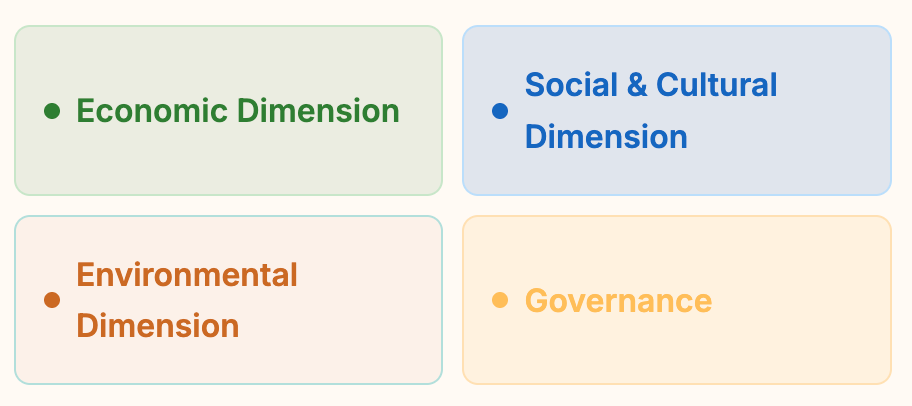
The three substantive dimensions reflect the structure of the Statistical Framework for Measuring the Sustainability of Tourism (MST), the global statistical standard adopted by the UN Statistical Commission in 2024 (see RMCMED & MST) and the commitments made in the Joint Statement of Messinia, which calls for development of coastal and maritime tourism along the lines of the three dimensions of sustainability — economic, social and environmental — and with respect to the principle of inclusiveness.
Governance is added as a fourth, cross-cutting dimension. Decisions about destination management, regulation, planning, stakeholder engagement and institutional capacity ultimately determine whether good policy intentions translate into measurable outcomes on the coast and at sea. Treating governance as a thematic group of its own makes those decisions visible and measurable in their own right.
Economic Dimension
The Economic Dimension monitors the contribution of coastal and maritime tourism to economic activity, employment, investment and value added in destinations across the Eastern Mediterranean.
Typical issues addressed under this group include the direct and indirect economic footprint of coastal and maritime tourism, employment in tourism-characteristic activities (including seasonality), the structure and productivity of tourism enterprises in coastal areas, investment flows and infrastructure capacity (including marinas and tourist ports), and the diffusion of tourism benefits from coastal hubs to inland and mountain regions — a priority explicitly identified in the Messinia Joint Statement.
Indicators in this group are designed to be consistent with the Tourism Satellite Account (TSA) so that data produced at destination level can be read alongside national accounts.
Social & Cultural Dimension
The Social & Cultural Dimension monitors the relationship between tourism activity and the people and cultures of coastal and maritime destinations.
Typical issues addressed under this group include the quality and conditions of employment in coastal tourism, accessibility for visitors with disabilities, the wellbeing of host communities (including the balance between resident and visitor populations during peak season), the protection and promotion of cultural and maritime heritage, intercultural exchange, and inclusiveness of the tourism offer.
The Joint Statement of Messinia explicitly anchors this group in the principle of inclusiveness, and the legal framework of the Centre (Law 5061/2023, Article 5) specifically extends the Centre's research mandate to accessible tourism.
Environmental Dimension
The Environmental Dimension monitors the pressures that coastal and maritime tourism places on the natural systems on which it depends — and the state of those systems over time.
Typical issues addressed under this group include the use of natural resources by the tourism sector (water, energy, land), the management of waste and wastewater in tourism destinations, emissions associated with tourism activity, the state of bathing waters and coastal ecosystems, marine biodiversity and the impact of recreational maritime activities, and the exposure of coastal and island destinations to climate-change pressures — a workstream explicitly raised between the Hellenic Ministry of Tourism and UN Tourism in Madrid in February 2026, covering sustainability indicators, risk assessment, thermal resilience, training programmes and risk-management tools.
Indicators in this group are designed to be consistent with the System of Environmental-Economic Accounting (SEEA)wherever possible, so that environmental data can be related directly to economic activity.
Governance
The Governance group monitors the institutional and policy conditions that shape sustainable coastal and maritime tourism.
Typical issues addressed under this group include the existence and implementation of destination strategies and management plans, stakeholder engagement at the local level (including consultation with the research community, the industry and host communities — a commitment expressed in the Joint Statement), the quality of public data and statistical capacity, the regulatory framework for coastal and maritime activities (ports, marinas, beaches, marine protected areas), and coordination mechanisms across the levels of government and across countries of the network.
By treating governance as a measurable thematic group rather than an implicit background condition, the Centre supports continuous improvement of the institutional foundations on which the other three dimensions depend.
How the thematic groups work together
The four thematic groups are not silos. The Centre's methodological framework — see The Framework — defines how indicators across groups are read together, so that, for example, an economic indicator (employment in coastal tourism) can be interpreted alongside a social indicator (quality of that employment), an environmental indicator (pressure on coastal water resources from peak-season activity), and a governance indicator (existence of a destination management plan that addresses both).
This integrated reading is what makes the difference between counting tourism activity and actually measuring its sustainability.